How to Cook up a Retreat
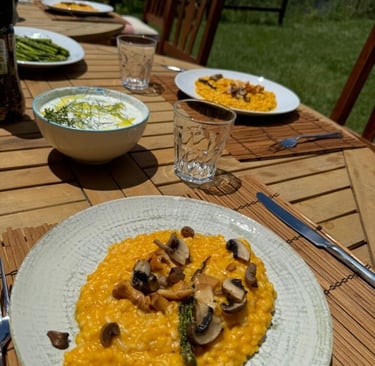
It’s now been two years during which we’ve offered a deliberately limited number of retreats (four per year), strategically planned with the intention of preserving what is special and unique about each gathering. When something is done too often, it becomes difficult to maintain the same level of presence—to avoid taking it for granted— as so often happens with cooking.
It’s not that I want to glorify the culinary arts or judge anyone’s cooking abilities. Rather, I find myself increasingly aware of the healing capacity of repetitive, everyday actions and the way they can bring order within us and around us and remind us that matter does not move at the same pace as information and screens. Emails travel from one end of the planet to the other in less than a breath, and if anything can still save us from the relentless frenzy of modern life, perhaps it is returning to the rhythm of gently sautéing an onion—which, thank God, will always remain an extremely simple process, yet one that requires sustained attention and patience that almost seem to belong to another world. Perhaps nowadays it is worth reclaiming these marginalised activities— those we often prefer to outsource— and placing them back at the centre, because they return us to a more human rhythm and remind us of our material nature.
At the beginning of a retreat, it is as if each participant moves to their own rhythm, which is generally fast, sustained by caffeine-fuelled and frenetic adrenal systems. Over the coming days these rhythms begin to converge into a melody that will be co-created. In this way, the tension and anticipation of the arrival starts to dissolve as the first faces arrive at the house, and I greet them while still moving between conversations and the stove, happy to be the guardian of nourishment for the days ahead.
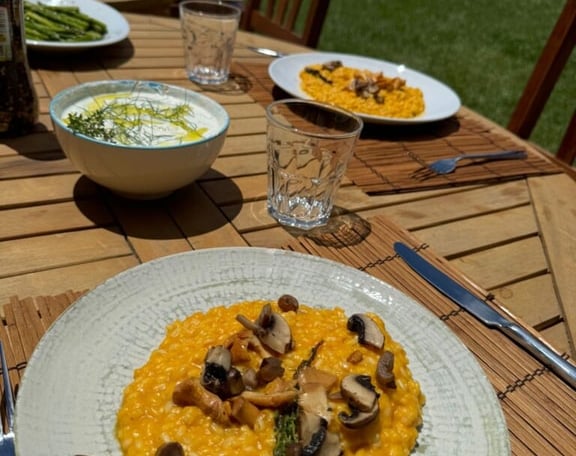
As has happened since time immemorial, when life was organised around the fire, the kitchen sets the pulse of the days. The act of laying out ingredients, taking out plates and utensils, allowing more hands to take part, bringing everything to the table—the unfolding that precedes the sharing of a meal, of which soon nothing will remain but a tidy kitchen, everything returned to its place, in silence, as if nothing had happened. This mundane act is always, for me, a reminder of the expansion and contraction present in absolutely everything around us—something that becomes obvious when we close our eyes after ingesting mushrooms. Repeated expansions and contractions which, in their succession, give structure to life.
The act of cooking appears as a kind of hologram of everything that happens in the phenomenal world, a reminder of the importance of order, ritual, and patience. Sometimes I wonder whether the qualities we associate with the feminine or the masculine are truly inherent to those genders, or whether they are simply the result of what we have traditionally been assigned to do.
The kitchen is also a place where each participant can share something of themselves, whether through a dish that they are keen to prepare or just by offering to chop the carrots or wash the dishes. Some people simply marvel at the alchemy that they witness taking place in the kitchen and show their appreciation through their enjoyment of the food. This space that precedes the sharing of food has a particular ability to allow each person’s energy to meet, and for each individual to intuitively find a place where they feel comfortable. Some sit at the table, introducing topics they’ve recently read about psychedelics; others sip an infusion; others still explore every corner of the magnificent house that will host us for the coming days.
There are also solemn moments later on, when we set the altar, light candles, form a circle, and sit in silence to listen to what others carry within. But that solemnity comes from a much more natural place when we have first broken bread together.
Recently I read something that really struck me—it spoke of cooking and nourishment as spiritual acts. It is said that you are what you eat. It could equally be said the way that you prepare what you eat tells you who you are. Personally, I am interested in our retreats being an honest place, without paraphernalia or pretension, where the mundane elements take on value—because those elements will remain present in your life; there is no escaping them. You may skip meditation one day, or not write in your journal, but you will certainly eat. So if you ask me, “How can I integrate a psychedelic journey?” I will answer: cook yourself a hearty stew.
There is no better way to energetically prepare for a group psychedelic journey and the releasing of layers and defenses that this involves, than to attend to the basics—to allow the space to become a home, and to find our place in it through acts which are simple but which connect us.