Putting the Magic back into Magic Mushrooms
On magic, disenchantment and taking a swipe at the psilocybin bros.
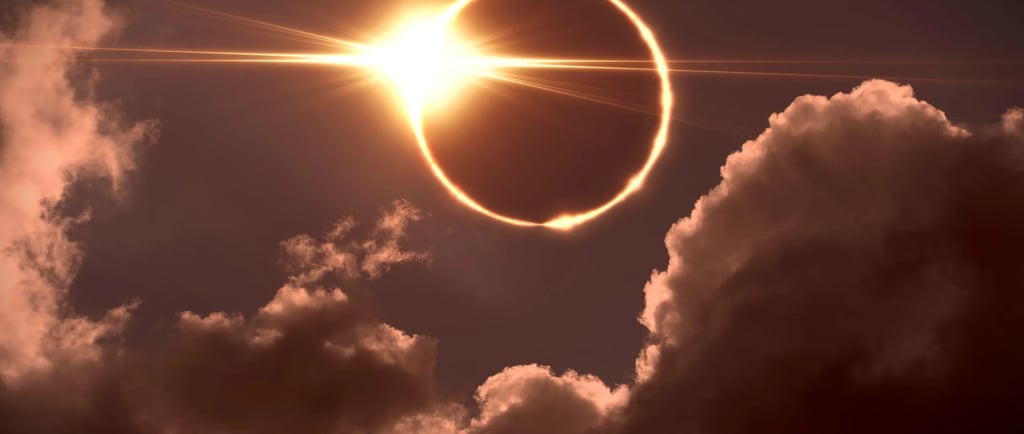
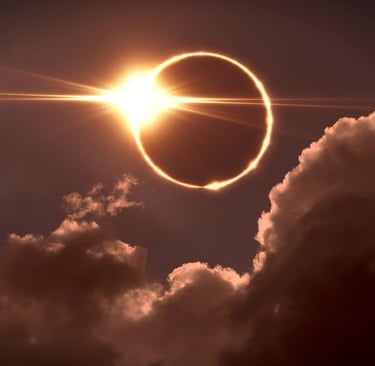
I was recently listening to a documentary about eclipses in which scientists were invited to relate their experiences of witnessing a complete solar eclipse. They struggled to find the words to explain the feeling that they had and used words that are often associated with mystical experiences- awe, wonder and, interestingly, full-bodied. Pressed by the interviewer to explain what she meant by full-bodied, the scientist talked about the shadow of the moon racing across the landscape towards her, about disoriented animal life making uncharacteristic calls, about the deep dissonance of seeing the stars suddenly reveal themselves during what had, until moments earlier, been daytime. And I noticed a sceptical, slightly bruised and wary part of myself reacting with the thought; sure, but it's all just physical bodies blindly interacting with each other, right?
I'm not sure that was my exact thought, but there was definitely an attitude lurking within me that, however exhilarating the experience might be, it surely wouldn't alter the basic disenchantment that I feel towards the world. This is an astronomical event which can be fully and exhaustively explained by astronomy, or physics, or whatever other discipline has jurisdiction over this particular natural phenomenon. Nothing remains unaccounted for. There is no mystery, no magic, nothing to see here. I
Disenchantment. Does this not describe our relationship to so much of the natural world? The spring is a beautiful thing to behold and refreshing to drink from, but at the end of the day, it is just water emerging from the ground according to well-understood principals of hydrology and hydrogeology? A mountain may inspire awe and respect, but in essence it is inanimate rock formed over millions of years as a consequence of the movements of tectonic plates, right?
We name and explain the world and in so doing, we somehow disenchant it and so become disenchanted ourselves. Don't physicists claim something similar? Don't they claim that the world exists in a state of pure potentiality until the moment it is measured and that at that moment it resolves into a fixed form. The collapse of the wave-function they call it.
The world as pure potentiality. What is that if not magic? In such a world the imagination has not been relegated to the margins of reality, but is integral to the creation of that reality. Reality is the fruit of a creative act dependent upon you and I.
How common is it in plant medicine ceremonies for the fire to become a manifestation of the mood of the room. As people are sunk in the interiority of their personal journeys, so the fire dies down only to leap back to life as people start to return to the shared space. Doesn't the mushroom experience teach that a reality that had, just hours earlier, seemed fixed and non-negotiable, is in fact wide open and as malleable as is our willingness to make a different choice? Don't we feel ourselves to part of a living web of creative expression?
The moment passes and we smile at our own credulity. But this is the process of disenchantment and no wonder the world lacks enchantment if we experience it as, at best, exterior and, at worst, lifeless. And yet what the mushroom experience teases us with is the possibility that, contrary to all our most deeply-held cultural assumptions, we inhabit a world that is saturated in consciousness from the most humble stone to the movements of heavenly bodies. Because anything that we direct our attention towards is retrieved from the realm of pure possibility and made fleetingly, tremulously real in that moment of focussed attention. But it never frees itself from the magical field of potentiality from which it emerged.
Which is another way of saying that the world is made of magic.
It seems to me that this is an aspect of the psychedelic experience that doesn't receive a lot of air-time when psiloybin-bros get together on podcasts to talk about microdosing and self-optimisation. That is why I prefer the name Magic Mushrooms to Psilocybin. Magic mushrooms invoke an experience of the world that is beguilingly, inexplicably magical. A world of endless possibility, playfulness and mischievousness. An invitation to play with the universe and experience how it can reciprocate. The focus on psilocybin and psilocyn, and the fascination with the bio-chemical functioning of these chemicals, seems to be in keeping with the extractive nature of our culture. We want to isolate the essence of the thing and put it to work in the therapy industry. However, such an approach risks extracting the magic from the mushroom.